The Likoni Ferry

I was somewhat lost, extremely confused, and kind of frustrated. I was 10,000 miles from California in a city called Mombasa on the South Coast of Kenya. I thought that I had proper instructions from my host to get to my Airbnb, but she posted directions from the train station (Mombasa Terminus), however, I was at MOI international airport. So, I had to figure out how to get to my apartment rental near Diani Beach and I didn’t like the $4,000 Kenyan Schillings price that Bolt (an international ride sharing app which is cheaper than Uber) was charging to get there. So, I decided to take a taxi about halfway there instead. This would put me back on track with the route that my host had given me. It would also require that I take the Likoni Ferry. This ferry ride would be an unexpectedly healing experience for me. It was profoundly spiritual and deeply fulfilling.

I’m aware that this must sound absurd to the average Kenyan. It must be the equivalent of someone saying they were moved to tears by the beauty of the people on the BART Train, or they had a cultural awakening on the back of an AC Transit Bus. We tend to not recognize the potency of what we see every day. Sometimes it takes looking at the world through the eyes of the tourist to see what we take for granted. My ride on the Likoni Ferry represented one of those super rare occasions when you recognize that you’re in a moment within the actual moment. I walked onto a boat with no less than 1,000 other Black people who brought bikes, had babies on their backs, and carried bags. I was no doubt the only “American” and probably the only tourist on the entire ferry. My Bolt driver advised me not to get on. I’m glad that I’m hardheaded and refused to take his advice.

I had an enormous suitcase that was 2 kilograms overweight at the airport, but the nice lady at Kenyan Airlines allowed me to slide without a penalty. I also had a huge burgundy backpack that I once used to go camping in Yosemite National Park for three days. It has several compartments, zippers, and hidden storage space. It’s great for backpacking, but it’s extremely conspicuous when it comes to city walking.  

“It’s not safe for you to take the ferry with those bags,” he said.

“Really?” I replied somewhat sarcastically.

My driver was a very long limbed but somehow average sized man named Peter. It took a few phone calls and me having chase him down in the Airport parking lot for him to see me when he arrived. This turned out to be a bonding experience for us. By the time I sat down in the backseat of his Hyundai I felt like we were homies. 

“Yeah.” He said sharply. “Anybody can go through your bag on the ferry. Be careful.”


Every African that I have ever met in Africa thinks Africa is the most dangerous place in the world. When I tell them that major American cities are way worse in terms of theft and violence they refuse to believe me. I once tried to explain this to a Liberian woman in Accra, Ghana. She shook her head then told me with a strong conviction; “No, America is heaven.” Of course I didn’t tell Peter any of this. I just said:

“Ok, I’ll be careful.” 

I actually appreciated his advice. It was just that my lack of speaking Swahili—the official language of Kenya— prevented me from explaining my perspective. I live my life knowing that I can be robbed, maimed, or killed any second. I’m always vigilant when I’m in public spaces and there was nothing that he could say to make me any more or any less aware of my surroundings. There was also nothing he could tell me to keep me from getting on that ferry. In fact, the more he spoke the more excited I got about boarding.


I was sick of being separated from normal Kenyan experiences because I was a visitor from a foreign country. The tourism industry is structured like a traveler’s ghetto in that the local government keeps you boxed in so they can control the outcome of your experience. The roads that you can walk down, the restaurants where you can eat, the people you encounter, and the way you commute is all predetermined. In the ghetto the ultimate objective is to keep you trapped at the bottom of society. In tourism the sole purpose is to manipulate your mind by giving you a watered-down version of culture while encouraging you to spend way more money than you should on items that you do not need. This stimulates the local economy and makes the billionaire hotel owners even more wealthy.


Think all-inclusive resorts. They keep you fenced in for most of the day. They give you a swimming pool, beach access, or both. They give you a menu with a few native foods and local juices alongside hamburgers, chicken strips, French fries and Coca Cola. They employ locals to serve you and perform for you. And they only allow you to move about the city in chartered vehicles that the hotels own. All of this while people live in squalor right outside the gates of your paid fantasy. Nah, I ain’t with it. I have never been with it. I was going to hop on that ferry with the people of Mombasa and I was ready to deal with whatever consequences came with it.

We had to get out of the car about 200 meters from the ferry station. Cars and tuk tuks are allowed on the ferry but the passengers must pay. Pedestrians and cyclists are free which was another major incentive for me to take the ride. Peter insisted on walking me to the security check-in. After I paid Peter, I was heading to the embarking point when three Kenyan security guards stopped me.

“Jambo! Jambo! You come here.”

I walked over to the men pulling my oversized suitcase behind me.

“What is in the bag?”

“My clothes. Most of them are dirty.”

“Open the bag.”

I opened my suitcase, and the main guard who was asking all the questions sifted through my belongings while noticeably avoiding touching my dirty drawers.

“Where are you from?”

“I’m from California.”

“Oh, USA. Do you bring a gun?”

“No, I left all my guns at home.”

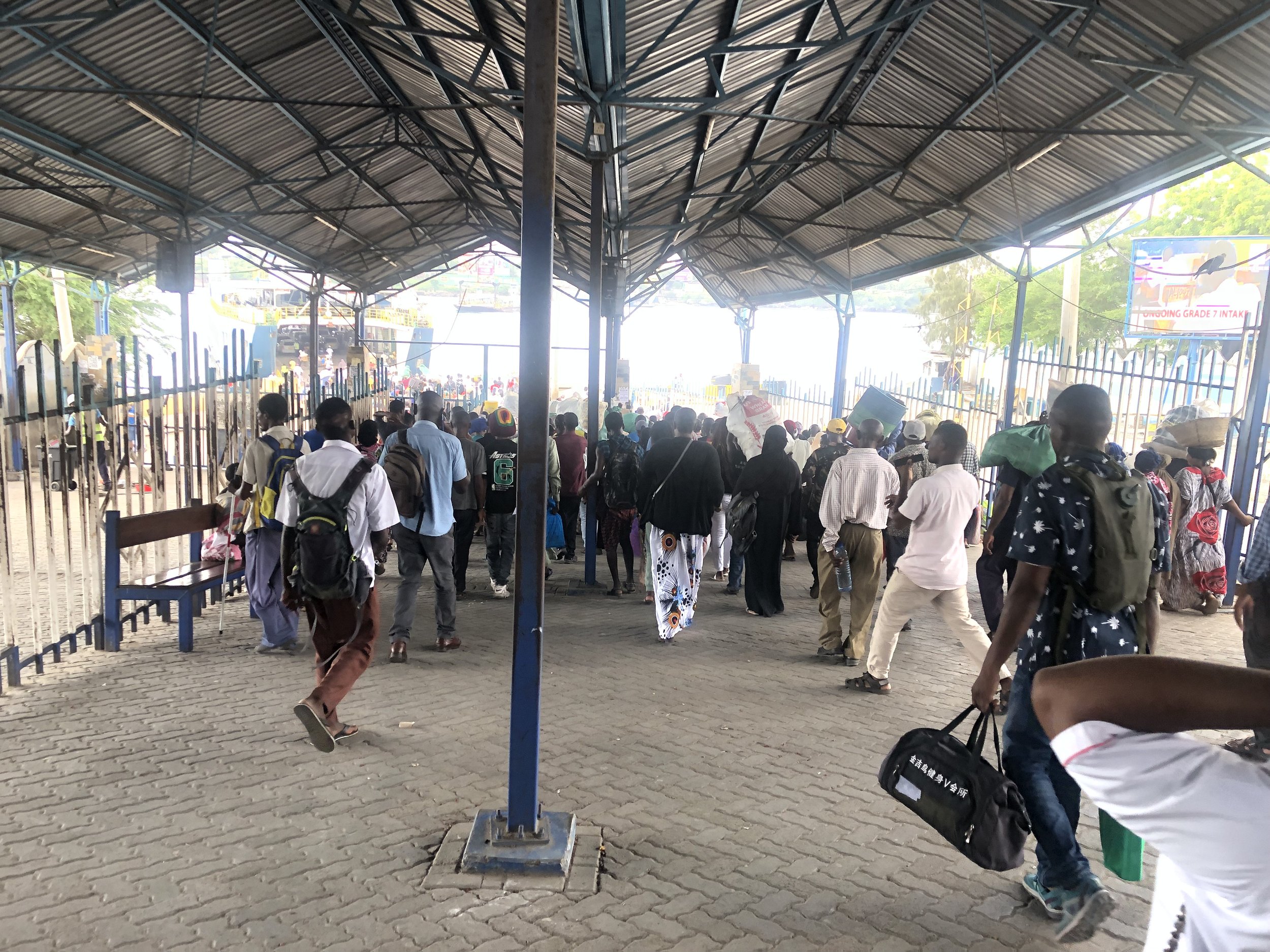
We both laughed, then he zipped up my suitcase and let me go. I walked into a large rectangular area with benches that were being quickly filled up. People had bags full of fish, beans, and clothes to sale on the other side of Kilindini Harbor. A woman walked by while gracefully balancing a large green sack on her head. A teenaged boy pulled up on his bike. A mother and father sat down with their two boys. The males in that family had clearly come straight from the barbershop because their lineups were immaculate. The people kept arriving. Each and every one of them had business to attend to on the other side. All of them moved with the familiar mundanity of a morning commute as it was about 9:30am.


I’m certain that they saw diversity in one another. I’m sure they could determine tribal affiliations by body type, gait, or skin tone. They could probably tell who was from the countryside and who was from the city based on accent and attire. Perhaps they could decipher who was formerly educated versus who had been working on a family farm their entire lives. I could not figure out any of these things, nor did I try to. All I saw was Black people and all I heard was the intermittent sounds of a soothing African tongue that I did not know how to speak. I was calmed by not being able to understand sentiments that might ruin my day. I was unaware of who was gossiping, who was cursing, who was being offensive, or who had a different political ideology than I do. I was blanketed by my obliviousness. I was comforted by what I did not know.  Then we began our descent.


It was time to be loaded onto the ship which was at the bottom of a cement hill. I walked in synchronicity with the people of Mombasa. I was in the middle of the crowd, in a country in Africa, headed into the bottom of a boat. I thought about the middle passage—the indescribably brutal tragedy that ripped my ancestors from the continent and forced them into chattel slavery for centuries—but this was not a kidnapping. This was a reconnection. This was an initiation ritual. This was a baptism into a culture that had the power to redirect my spirit. I was being reunited with everything that had been lost. I pulled my luggage behind me onto the vessel, and I carried my backpack like a thousand burdens on my back. I did not stop walking. I did not speak at all. Even when asked a question in Swahili I just shook my head, no. I did not want to speak English. I did not want to be an American. I did not want to be an individual. I wanted to be at peace. I wanted to be whole and move within a body of people striving toward a singular destination. As I found my position on the ship, I looked up to my left and saw black people going up the stairs to the next level. I was surrounded by the Kenyan people—my people, whether they knew it or not. And as the powerful motor of that ferry propelled the entire lot of us across the water, I knew that I belonged. And I knew that I was safe because everyone was far too preoccupied with their own bags to be concerned about taking mine

Merging in Accra

In Ghana everyone drives crazy. But it isn’t crazy to them, it’s only crazy to the outsiders. In Accra there is big city traffic with very few traffic lights. There are roundabouts full of motorbikes, buses, taxis, vans, and Hyundai’s–yet somehow everyone is able to successfully merge. I have yet to see one accident. People always honk; however, they don’t lean on the horn for thirty seconds as the drivers in Chicago and New York do. It’s more like a courtesy. There is nothing manic about the way people drive in Accra. The people understand the basic fact that the road belongs to everyone. 

Merging in Accra feels very dangerous if you’re sitting in the front seat of a Bolt. Your driver accelerates into oncoming traffic. He seemingly lurches right into another vehicle, and you brace yourself for an accident that never happens. He never makes contact with the other car. The other motorist breaks at the very last second. Miraculously, the other driver doesn’t put his head out of the window and scream something profane about your driver’s mother. Nor does he take out a pistol and start shooting. He just yields. That’s it. It always happens that way. I’ve seen evil looks and aggressive horn taps, but I haven’t witnessed any road rage, and I haven’t seen any accidents at all. This, in one of the most congested cities in West Africa with potholes one meter deep, very little white paint on the asphalt to indicate lane separation, and almost no stop signs. The Ghanaian people just make it work. I don’t know if car insurance is even a thing here. If you order a car from the ride sharing app called Bolt, then there is a 90% chance that the seatbelts in your car will not work. All you have in terms of safety are faith and prayer. The drivers though–to their credit–always get you to your destination. They must maneuver through motorcycles with entire families on them including three small children. They turn down blind backroads with pedestrians, stray dogs, and other vehicles only alerting their presence with the sound of their motor and two rhythmic honks of the horn; “Beep, beep.” Everything is harmonious. The drivers of Ghana loudly speak the language of their commute even if you can’t comprehend it just yet. They demand that you learn it through immersion. There will be no accommodating and no negotiations.   

I am not a Minority: My Revelation in Ghana

Ghana feels like the whole sun. It looks like a whole tree. And it tastes like a whole cake.

 At some point when I was there I realized that I had only been given pieces of what’s essential to my being, and I had made the best of it, but in the pit of my soul I felt like I deserved more. I always thought that there was something else. Well at the market place outside of Kumasi in the Ashanti region–I experienced that something else. 

There were probably no less than 10,000 people shopping for everything from cow heads, to backpacks, to ice cream. There was a buzz both inside and outside of the mall that felt like downtown New York City at 2:00pm in the middle of July. 

There were men getting haircuts, women getting weaves, teenagers getting new cases for their cell phones, hundreds of babies being carried on the backs of mothers who were vending and mothers who were shopping as well. And all of them. 100% of them, were Black. It was very overwhelming for me, a Black man from a city that is 25% Black, from a country that is 13% Black, and a state that is only 6% Black. 

As I sunk further into my thoughts and began to be less verbal with my tour guide, a mighty revelation began to bubble over the cauldron of my being: I AM NOT A MINORITY. I am not a tree without roots, I am not lost in the wilderness of North America. I am not living in a small ghetto allowing the dominant class to define what it means to be me. I am a drop of water in a beautiful black sea. I am being baptized and cleansed from a lifetime of geographic limitations. I am not relegated to a neighborhood, or a part of town. The entire world is mine. I may travel as I please, I may think as I please, I may do as I please. I am not a part, I am whole. I represent one whole mind, one whole body, and one whole soul, working together to liberate my sullied perception of my place in the universe.         

A Mirror Called Haiti

image1

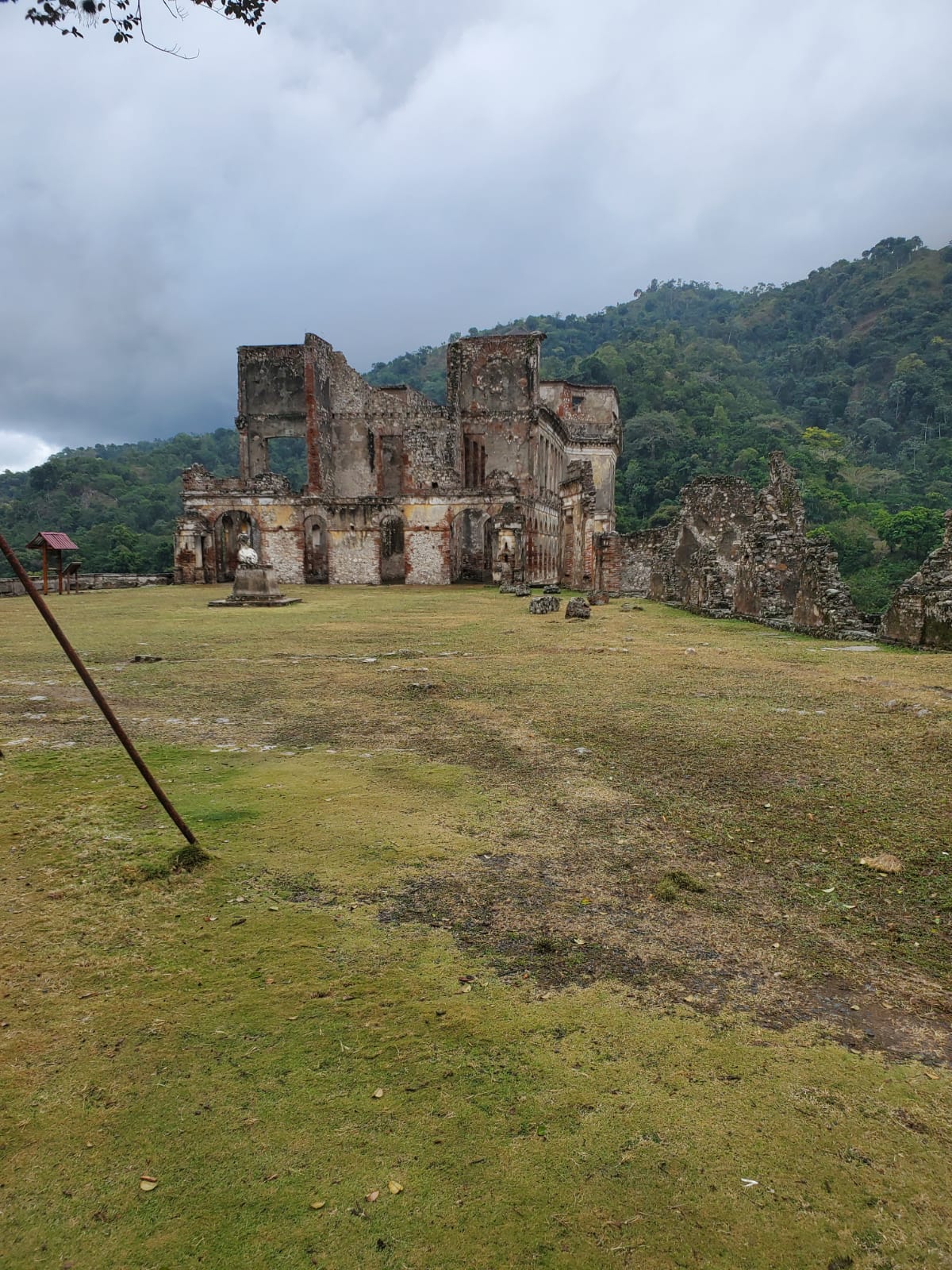
I have spent over a week trying to put my trip to Haiti into perspective. I have been searching for the words that would not only convey my affinity for the nation but would also speak to the very real feeling of precariousness that is currently gripping her. What I have come up with is this—close your eyes and imagine that Deep East Oakland is an entire country. Now open them. What you see is Haiti.


There is at once so much pride in the people, so much righteous resistance in the history, an enormous amount of potential, and a nearly extreme amount of dysfunction. One day after going up a mountain to see the very stunning Citadelle Laferrière and the ruins of the Sans-Souci Palace we stopped by a cultural center in the town of Milot. They welcomed us with African drummers and upon entering we washed our hands with the assistance of a female member of the center. Much to my surprise they were in the process of cooking for us. The lead organizer of the center, a black Haitian man of about 60, explained to us that he didn’t know what exactly was being prepared because he didn’t know what the fisherman caught that morning. He went on to say that they had been without power for several days—which isn’t unusual for Haiti. What that means, he went on, is that we don’t have a refrigerator therefore we must eat whatever we can catch on any given day. Then the next day we fish again.


After giving us an introductory history lesson on the town of Milot the food was brought out. It consisted of fried plantains, beans, rice, and two different kinds of fish one grilled and the other fried. The fish was extraordinary. It was way better than anything you can buy at a grocery store. What I found to be even more amazing is that even after having seconds I still felt very light. Unlike the meat here in the U.S. the food didn’t weigh me down at all.


As we we ate the food the lead organizer thanked us for coming. I was accompanied by a small group of African-Americans and one Haitian tour guide. The people at this center had cooked for all of us, went out of their way to make us feel special and this man still insisted on thanking us for visiting Haiti despite the unrest that was taking place all around the country. I felt a sense of kinship and belonging that one can only feel in a predominantly black country. It was almost emotionally overwhelming for me.


Then on the way back to our hotel the tension of national instability grew thick once more. Apparently, the disgruntled police force set several fires on one of the two bridges that leads to Cap-Haitian. They were upset because they believe they are being underpaid and instead of paying them the government was set to spend what the police thought was an excessive amount of money on the annual Kanaval celebration. So they decided to do everything in their power to shut Kanaval down (ultimately, they succeeded). We traveled over the other bridge which they had emptied several dumpsters full of trash and debris upon in an attempt to block it as well. Luckily for us we were in a larger vehicle that had the ability to drive over the makeshift roadblock. While sitting in the backseat the bumps from driving over all of the junk made me feel as though I was off-roading up a mountain in a Jeep—it was wild as hell but we made it back safely to the hotel.

Growing up in East Oakland I remember parties being shut down just like Haitian Kanaval while I was in line waiting to get in because a kid got jumped or someone pulled out a gun. I remember sideshows being descended upon by police the second I turned my engine off and got out of the car. I remember, on multiple occasions, feeling like my community couldn’t have anything. And when we would get something nice such as a new store, apartment building or transit center, I would just wait for it to be torn up by my people. These same feelings washed over me on the way back to the hotel that afternoon. And they troubled me in the exact same manner that they did when I was a teenager in the ghetto.


Citadelle

My trip to Haiti was full of black power highs and post-colonial lows. There were moments of bliss when I would be in total awe of the oldest black republic in the western hemisphere that would be immediately followed by the fear that it could all implode at any given second. Haiti, in this regard, is not unlike the South Side of Chicago or the West Side of Philadelphia or Deep East Oakland. Haiti does not pretend to be paradise. Haiti is no tropical escape for black people either. Haiti is a mirror for the descendants of African slaves. And finally, Haiti does not lie to make tourists feel more comfortable. It is for these reasons that I love her.

-Roger Porter

image3

Utah

750270D9-8355-4F9A-8D60-652037E6187F

The humongous state of California can feel claustrophobic at times. As of late these times have been occurring much more frequently. A few weeks ago, I sought to leave. I felt like if I didn’t cross the state line then bad things would happen to me. I was imploding. There’s really no other way to put it. So, I headed east. And quite randomly or maybe one can say it was by god’s design, I wound up in Utah. As I traveled through the state I was shocked by all of the natural beauty. The red clay was very reminiscent of Arizona but it wasn’t as brightly colored. It was more subdued. The landscape on either side of the highway was so striking and the canyons were so picturesque that I found myself pulling over at every looking point. Each time I stepped out of the vehicle I further internalized the fact that I was a long way from Oakland, CA.

7710D610-F7DC-4084-9ED3-4E16C2FCCD80

The beauty of the state was amplified even further when I got to Bryce Canyon National Park. As I admired the shapes of the rocks in the canyon from the top of a trail something told me to look up into the sky and when I did I was forever changed. The perfectly formed clouds stood still and they accentuated the endless blue surrounding them. I’m from the west coast so I’m used to looking out at the Pacific Ocean and feeling like a speck of dirt amongst its vastness. I have never, until that moment, looked toward the sky in the middle of the day and felt the same way. There was so much sky. It was unpolluted. It was clear. It was humbling as well as comforting. I trusted the sky. I felt protected by it. I was enamored with its unwavering presence. I thought of my father and my grandparents. My friends and all of my ancestors and it brought contentment. I knew that their souls were there and I knew that mine would be there one day as well, and I was ok with that. I was at peace with where I was and where I would ultimately end up.


I took a picture which is my attempt to capture something that could never be captured. The peace that I gained in that moment has been a lasting one. I never thought that Utah would be the place that I would go to heal but that’s how it played out. And now whenever I feel downtrodden I stop and look up before I continue my life.

Out on the Balcony

I was on my bed considering my journey, contemplating all of the things that had taken place in order for me to arrive in the space that I currently occupy. Then I heard a violent noise. The noise seemed to vibrate the windows and smash against my back door. Then I heard the sound again and it had a similar effect on the structure of the house, except this time it was a little bit louder. I gathered myself and rose slowly, contemplating whether or not to get a weapon before I walked in the living room area to see what was going on. I opted not to. I took silent ninja steps to the window and peered out of it to see that the cause of my consternation was the Atlantic Ocean crashing against the Jamaican shore which was just a few feet from the Montego Bay estate that I was staying in for the night.

DSC_0057

I very rarely leave the United States. I almost never kick back and enjoy life, but last week I was on a solo trip to Jamaica when I saw those waves crashing against the beach and then rolling back into the sea. The rhythm began to saturate my soul. The consistency, the majesty, the power of it all—it got me. I stepped out on the balcony in astonishment. I submitted to the moment. I looked but did not move. I forgot that I was breathing. I appreciated the world and I told myself, I deserve this.

-YB


The GO-GO Sound

I was approaching Baltimore Harbor when I heard the same syncopated rhythm that I heard intermittently on my one hour journey from Washington, D.C. Except this time it was live! It was right before my eyes so I could see the masterpiece as it was being created with two drumsticks, three buckets, a trash can, and a basket from a grocery store. What the man was creating was a sound called GO-GO. It made me want to dance, pray to my ancestors, and take the finest sista I saw back to my dingy little room at the Motel 6. It made me feel at once liberated and a slave to all my passions. It reminded me that I was an African, but also that I was very far from home.

They don’t play GO-GO music at all in the San Francisco Bay Area. I mean like never. I only know what it is because several years ago I asked a friend of mine that had gone to Howard what it was like to party in D.C. and he told me “The girls out there really like GO-GO.” I looked at him quizzically thinking that he was saying that they were strippers. I kept thinking GO-GO dancers and for some reason I conjured up Demi Moore’s dance routine in the movie “Striptease.” Thankfully he began to explain it to me. “It’s like that Amerie song. That’s kind of like GO-GO…ok ok you remember that song ‘Doing the butt’? Now that song is definitely GO-GO” It was only then that I understood. But that song was from the “School Daze” soundtrack. I think I was in the 2nd grade when that came out and after they stopped playing it on the radio I never heard anything else like it. But that was obviously because I had never been to Baltimore or the DMV.

So “Doing the Butt” isn’t just a song but rather it’s part of a movement that has been going strong for several decades. Like stepping in Chicago and Going Dumb in the Bay, GO-GO is a D.C. thing. And as I listened to it I felt very deprived. Why hadn’t I known about this? Why hadn’t this sound made its way to the bay like Trap Music, House Music, or Dance Hall? I was so enamored with how the continent of Africa had touched the region where I was vacationing. The sound I was hearing was so ill, it was so lit, it was so pure. I was feeling it. I put a little money down in front of the musician and left on my way to get crab cakes which were better than the ones they sell in the Bay Area but definitely didn’t live up to the hype as far as all of the fantastic things that I had heard about them, but there were no expectations for my experience with GO-GO. GO-GO somehow remains D.C.’s secret. GO-GO is an uncorrupted manifestation of ancient African musical expertise. I had to travel across the country to hear this sound and the journey was worth it.

HerStory

EPIC! That’s the first term that comes to mind when I think about the long journey of bringing “Herstory” to fruition. It was March 30, 2012 when I sat down to conduct my first interview with Niema Jordan in my shabby East Oakland living room. When we finished recording our conversation I thought the project, in its entirety, would be complete within two months. I was hella wrong.

So many bad things happened that my selective memory won’t even allow me to recall most of them. I do remember amicably parting ways with my original editor halfway through the project. I do remember at least two other people committing to the project only to back out once they were able to truly internalize the fact that I could not pay them. And well, everything else is a blank until I reconnected with a fellow Skyline High School graduate who possessed the skill set and the passion to bring Herstory back to life. It was February 11 when she committed to the project. Now seven weeks later it’s done.

I’m high right now. I mean I’m super elated. I’m glad that Herstory survived all of the abandonment that it was exposed to in its infantile stages. I’m glad that beauty still exists in this world and I am so grateful that I have crossed paths with three super dynamic black women that opened up to me and told me their stories. With no further ado this is Herstory: