That was a G move. I can’t think of any other way to say it. If what is being reported right now holds to be true then Donald Trump is a certified gangsta. And I mean that in a very hood sense. I mean that as a superlative. I don’t mean it in the sense of him possessing political documents in his home or paying a prostitute from the wrong stash.
Donald Trump the narcissist, the egomaniac, the bully, the blah-blah-blah. Man listen, what he did on July 13th was hard. He was grazed in the ear by a bullet from an Ar-15. Had the bullet landed four inches to the right then his brain would have been on the floor of that stage, but it didn’t. Instead it streaked past his ear and he was tackled by secret service agents for his own safety. A few short moments later they got back up on their feet and escorted him off the stage, and with blood streaming down the right side of his face, he put his fist in the air and the crowd went bonkers. A couple of seconds later he did it again and they chanted “U-S-A! U-S-A!” I felt a rush of ice water flow through my veins when I saw this, and then I stood up straight. I was with him. Me, the man that did not vote at all in 2016 and voted for Kanye West in 2020. Me, the man that hates the U-S-A chant and refused to shout it in 2001 after the twin towers fell, and on the night that Barack Obama was elected in 2008. I do not endorse politicians and I very rarely do patriotism, but yesterday I found myself doing a little bit of both. For this incident conjured up a palpable sense of nostalgia in me.
When I was in primary school my cousins and I were playing football in my aunt’s yard on 55th Avenue in East Oakland and somehow the ball kept going over the neighbor’s fence. Her neighbor was a mean drunk named Stanley. He hated kids and he hated life. And he especially hated his life when me and my cousins, my aunties, my uncles, and my grandmother would all gather at my Aunt’s house for a family dinner. He begrudgingly threw the ball back to us the first time and then the second time it went over he refused to give it back. My older cousin, seeing how distressed we were about the ball, decided to hop the fence and get it for us. Stanley didn’t like that. So when he saw my cousin jumping over his fence from his window he went into his house and got his switchblade. He walked with vindictive intention toward my cousin.
He was one foot away when he flicked open the knife, and said;
“You went on my property mutha fucka?”
My cousin got in his karate stance and quickly retorted;
“If you gone stab me then stab me.”
We all circled the commotion then my cousin repeated himself with more confidence;
“If you gone stab me then stab me!”
Stanley wasn’t ready for this. A few of my aunties screamed; “Oh my god!” Then Stanley slowly retreated towards his house. “Yeah mutha fucka.” He said as if he had actually done something, and he went back inside. My cousin was 15 years old at the time and I was about six, but for the rest of my life I will never forget the moment when I realized that my cousin was a G. He wasn’t afraid to die. That’s what’s at the core of the gangster identity and that’s what Donald Trump exhibited last night. His defiance spoke to something very primal in me. The part of me that respects the inner savage in someone else. I saw into the soul of Donald Trump and it said “You gone have to kill me, because I’m not going to cower.” That’s hard. That’s gangsta and I don’t care what anyone says. I have to respect it.
My mother never wanted to come to California. It’s this simple truth that has shaped the way that I look at my state, the way that I look at the history of black people in this country, and the way that I look at the idea of integration. It’s also shaped the way that I look at my mother, and even the way that I look at myself.
Her story starts in Fort Smith, Arkansas–a very white town with a few small but fully self contained colored sections. She was raised by her grandparents. My great grandfather was a barber, a preacher, a porter on the Missouri Pacific Railway, a handyman, and an architect…well an architect in a very southern way. Meaning, when more of his grandchildren began to move in and the house needed to be expanded then he would be the one to build the extra room–by himself. No contractor, no approval from the city, no blueprint, no workers. Just a man that saw that something needed to be built so he built it. He was 6ft tall, prideful, and domineering. My great grandmother, on the other hand, was a domestic worker at the Goldman Hotel in downtown Fort Smith. She was 4 feet 11 inches tall, everloving, and very sweet. Oftentimes too sweet for my great grandfather’s liking.
“I don’t know why you let them people talk to you like that,” he would yell at her after she told him something that happened at work. And she would take his scolding lecture just like she would take the verbal abuse from the white folk at her job. He made her just a little harder while she made him just a little softer and together they provided the perfect environment for my mother, Evelyn, to thrive.
My mother was a phenomenal student and a stellar athlete. She won the physical fitness competition every year in grade school. She played the clarinet in the marching band. She was on the softball team and she was a straight A student. She had four siblings that she shared a home with. The rest of her younger brothers and sisters lived with her mother and stepfather in California. Of all the children though, my mother was the most gifted academically. She would be the first person on both her mother and her father’s side of the family to attend college. My mother had been elected as the student body vice president of Lincoln High School at the end of her sophomore year. Which meant she would serve her term as VP of her junior class and then as a Senior she would automatically be selected as student body president of the entire school.
Her term as president of Lincoln High School would have been the pinnacle of a brilliant k-12 academic career. It also would have been a source of enormous pride for the family. Lincoln High School wasn’t just an institution, but it was the hub of Black Fort Smith. It was the location of bake sales, talent shows, fish fries, community meetings, and football games replete with scintillating halftime performances by the band. To say that your grandbaby, or your sister, or your brother, or your daughter, or your son, or your niece was the President of Lincoln High School was almost like saying you’re related to the mayor. You had clout. It meant that your family was going places. As a grown man I can see how elated my mother must have been when she won that election. Her radiant smile and glowing brown skin must have lit up the school everyday until summer break. Unfortunately, it would be that summer that she would receive the news that would ultimately dim her light and rearrange her entire Universe. The year was 1966 and Governor Orval Faubus had decided that it was time to enforce integration in the state of Arkansas. His strategy in most municipalities was to close down the Black schools and bus the Black students to white schools. This meant that Lincoln High School in Fort Smith would be no more. My mother was to be sent to the previously all white Northside High School. An atmosphere that would be hostile and repressive.
My great grandparents knew that my mother wouldn’t be allowed to participate in the band, she would not have been placed in honors classes, and she most definitely would not be student body president due to her blackness, so they decided to send my mother to San Francisco to stay with her mother, her stepfather, and her younger siblings.
(My mother standing in front of what once was Lincoln High School.)
When I asked my mother what went through her mind when she was told that she would be moving to California she responded, “I braced myself to roll with change. I knew that the change would be greater than anything I had ever experienced.” Then I asked her if she cried,” and she said “Nope.”
She didn’t weep. She didn’t become lethargic. She didn’t rebel. She joined the band at Mission High School in San Francisco. She played softball. She was enrolled in honors classes, and was ultimately accepted into UC Berkeley. While at Cal she met a law student from Covington, Tennessee. They fell in love and had three children, the youngest of them being myself. Eventually the family moved to Oakland where my siblings and I were raised.
As a kid we used to beg my mother to tell us stories about her childhood in the South. This normally took place when it was time for us to go to bed and we wanted to stay up just a little longer. More often than not my mother would oblige. Her face would become luminescent as she reached back into her memory into the time in her life before she caught that cheap Continental Trailways bus to San Francisco. Before she was ordered to be integrated into an institution with poor whites who, if they knew nothing else they knew that they were above her. She would conjure up stories from a time when her grandparents who raised her were still alive. When her little brothers and sisters and mother were in town for the summer. When her village was complete. When part of her chores would be to wring a chicken’s neck and she learned the hard way not to befriend any of the livestock because one day your little pet would be on your dinner plate. She would think back to when they would ride pigs and hunt squirrels and they would be fist fighting each other one day and cooking for one another the next. When my oldest Uncle was a star running back at Lincoln High School and at every game my mother would awe at the precision, discipline, and artistry of the marching band. She couldn’t wait until it was her turn to represent that most cherished institution.
As the movie played out in her head she would smile and we would laugh hysterically as we sat Indian style on the dining room floor. I envisioned all of her stories in black and white. As she told them I thought about I Love Lucy and Leave it to Beaver. They seemed to speak to a classic era of love and simplicity. And she spoke with a palpable sense of nostalgia that stood in direct contrast to everything that I was learning about the South in school at the time. My mother had never seen a lynching or a crossburning. She had never been sprayed with a water hose and had never seen a Klan rally. She had never run home crying because a little white girl didn’t want to be her friend. She talked about her little pocket of the South as if it were the safest place in the world. As if it were nurturing and healthy. My mother would lose track of time and we would stay up over 30 minutes past our bedtime listening to her stories. She never wanted to come to California. She never wanted to leave the South. This was always very evident. And that’s why I always questioned the videos of the Black people who exposed themselves to physical violence and abuse in the name of integrating a lunch counter. This is why I couldn’t quite understand how a black parent would willingly send their 6-year-old child into the lion’s den of an all white school without any administrative support or any other child who looked like them to talk to, in the name of progress. We had our own schools and our own restaurants. Our own dreams, our own ambitions, our own bands, our own softball teams, our own scholars, and our own achievements that existed apart from the white establishment. But yet we have been conditioned to celebrate the sacrificing of our business districts and the traumatization of our children in order to live an existence as eternal dependents begging for entry intothe house of a man who hates us.
I love the state of California as does my mother. We love the Redwoods, the wine, the hills, and the Pacific Ocean. I would be remiss, however, if I did not say that this love was forced by a political order that was recklessly implemented with a flagrant disregard for the development of black society. My mother never wanted to come to California, and she should have never had to.
Bipping is a post pandemic phenomenon that feels as indigenous to the Bay Area as sideshows and Mac Dre murals. I’m aware that it happens in other places but members of the criminal underworld in Oakland have mastered it. As a matter of fact, if it were a college course then it would have to be taught at either Cal State East Bay or UC Berkeley. The art of breaking into cars and stealing all valuables inside of it in 8 seconds or less, taught by Professor Lil Hyfee/Sociology Department/3 units.
Celebrities like Alex Rodriguez, B. Simone, and Lyfe Jennings have all been victims of this crime while visiting the Bay Area. And tens of thousands of folks just trying to make a living, get their cars hit up every single day in The Town. People like me.
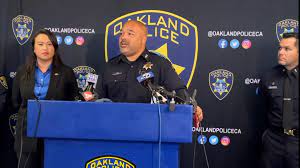
Last summer I got my car window broken and I literally had nothing inside my car. I caught them trying to pull down my backseat and get into my trunk. I screamed, “Yooooo!!” and the wiry teenager got into an awaiting car and they drove off. I felt frustrated, violated, and enraged. I had to pay $475. The vandals were off to the next car with no consequence. That was over a year ago. Now thieves have gotten even more brazen, but how? Why? Don’t they face any repercussions for doing this? Well, according to Assistant Chief Tony Jones as well as the rest of the Oakland Police Department, the answer is No.
In a video recently uploaded to X, he stated in what appears to be a town hall meeting, that because of Prop. 47 if they catch someone in the act of breaking into a car and that person has an ID then they must cite them and let them go. But San Francisco public defender Jesse Hsieh rebutted this claim. He said that smash and grabs and car burglaries are indeed felonies and he gets several cases for this crime. He went on to say that he was trying to figure out how the same crimes are felonies in San Francisco but citable offenses in Oakland. Then there was silence. Finally, Assistant Police Chief Tony Jones says, “Well maybe I misspoke.”
This was one of the most embarrassing exchanges I've seen in this body, but I have no doubt that if Hsieh were not there with the current construct of the Commission, this would not have been clarified for the public, with attendant conclusions–OPD is not pursuing these crimes pic.twitter.com/Lnl8xnSRnE
No potna! You did not misspeak. The Oakland Police Department is intentionally letting people rob The Town blind. Admit that you all are still harboring a lot of resentment from the Black Lives Matter/Defund the Police Movement. And now you want to bring every activist and George Floyd sympathizer to their knees for being recalcitrant. Once we beg you for forgiveness (a process that some have already started in the media and in city council meetings) then you will be able to hire an abundance of police, change laws to arrest more people which will ultimately lead to more prisons being built, and then you all will be able to get back to aggressively shaking down innocent Black people who look “suspicious,” and there will be no organization powerful enough to chastise you because all you’ll need to say in your own defense is; “You see what happens when we let them run amuck. Let us do our jobs or the mass bipping will come back tomorrow.”
And I know all of this may sound like a conspiracy. I don’t deny being a conspiracy theorist because, as a wise person once said, “The only difference between a conspiracy theory and the truth is time.” The fact that a city such as Oakland situated just north of the Silicon Valley, right across the Bay from San Francisco, with an International airport, a major league baseball team, a rich legacy, and over 420,000 residents can decide to decriminalize car burglaries is beyond absurd. We should all be very concerned about our Assistant Police Chief’s comments and how they have led to a golden age for Bippers in Oakland.
About a week ago I sat down with the incomparable young South African scholar Dr. Pedro Mzileni. This conversation resulted in an exhilarating dialogue about the Revolutions that are taking place in several African countries right now. Check out the video below to see exactly what I’m talking about.
Ghana feels like the whole sun. It looks like a whole tree. And it tastes like a whole cake.
At some point when I was there I realized that I had only been given pieces of what’s essential to my being, and I had made the best of it, but in the pit of my soul I felt like I deserved more. I always thought that there was something else. Well at the market place outside of Kumasi in the Ashanti region–I experienced that something else.
There were probably no less than 10,000 people shopping for everything from cow heads, to backpacks, to ice cream. There was a buzz both inside and outside of the mall that felt like downtown New York City at 2:00pm in the middle of July.
There were men getting haircuts, women getting weaves, teenagers getting new cases for their cell phones, hundreds of babies being carried on the backs of mothers who were vending and mothers who were shopping as well. And all of them. 100% of them, were Black. It was very overwhelming for me, a Black man from a city that is 25% Black, from a country that is 13% Black, and a state that is only 6% Black.
As I sunk further into my thoughts and began to be less verbal with my tour guide, a mighty revelation began to bubble over the cauldron of my being: I AM NOT A MINORITY. I am not a tree without roots, I am not lost in the wilderness of North America. I am not living in a small ghetto allowing the dominant class to define what it means to be me. I am a drop of water in a beautiful black sea. I am being baptized and cleansed from a lifetime of geographic limitations. I am not relegated to a neighborhood, or a part of town. The entire world is mine. I may travel as I please, I may think as I please, I may do as I please. I am not a part, I am whole. I represent one whole mind, one whole body, and one whole soul, working together to liberate my sullied perception of my place in the universe.
We woke up to Alice Coltrain playing on my Spotify. I rolled over to your side of the bed and as Alice played the piano I played with your FUPA. You very sweetly told me to stop–I did not. Instead, I laughed. You tried to pry my fingers away. I leaned in to you. I was the big spoon. I turned you around to kiss you. You said your breath stank and covered your mouth. I said, “Mine too. Why you trippin? I like that.” You said that I was nasty, but you let me kiss you anyway. This is how we spent the morning. In and out of consciousness and in and out of one another while Alice played the harp. And thank god it wasn’t vinyl because neither one of us would have been able to exercise the restraint necessary to get up and turn the record over.
Joe Camel was everywhere when I was a child. He was on television, he was on bus stop benches, and he was selling cigarettes on billboards in the same manner that Billy Dee Williams was hawking Colt 45. This was the late 1980s which represented the last days that such blatant targeted advertisements would be allowed in the African-American community. My childhood was impacted by Joe Camel in the same way that kids of today are being impacted by Blueberry vape pens. The drawing of Joe Camel smoking a cigarette as he played a game of pool was hella fly to me. In my young preadolescent opinion, even though he didn’t speak, he was the dopest cartoon image ever. He had more charisma than Bugs Bunny and was a bigger boss than Leonardo from the Ninja turtles. Even more significant than that was the fact that he was the mascot for my Uncle Red’s preferred brand of smokes. Which meant that he was present at my grandmother’s house, family get togethers, or where ever my uncle happened to be.
When I was little I thought my Uncle Red was the coolest man in the world. Partly because he had been to prison and partly because he used to be a pimp, but really because he smoked Camel cigarettes. He would blow smoke rings in the backroom of my grandmother’s house and let the kids break them up with our fingers. He had a thousand stories and never told the same one twice. In retrospect all of them were wildly inappropriate for a boy in elementary school to hear, but I still soaked up all of his game like a sponge. Anytime I was able to walk with him down 3rd Street in the Bayview section of San Francisco or down E14th in East Oakland it was like basking in the light of a celebrity.
Uncle Red is sure to walk on the outside of me and my cousins so that he is the one closest to the traffic. He lets us run to the corner while he stays behind with a Camel cigarette pursed in between his lips. We make it to the corner and stop to wait for him before we cross the street. I turn around totally out of breath and look back at my uncle who is taking out his lighter to light up another cigarette. He is wearing white leather platform shoes, white bell bottoms, a white button up shirt, a white blazer, and a nappy chest. His hair is combed back. His hairline is barely receding. The sun catches his bronze complected face in a way that makes him look like a mixture of Goldy from The Mack and Joe Camel himself. By the time he catches up with us we have caught our breath. We walk together across the street and into the liquor store where I get animal crackers and a soda. My cousins get Lemonheads, Jolly Ranchers, and Funyuns. My uncle asks for Camel Menthols which are behind the counter. Uncle Red pays for everything. While he steps out of the door he flicks his cigarette butt onto the concrete and I run to step on it first. He opens up the new box of Camel Menthols and shakes another cigarette into his palm, then he places it into his mouth. My cousins and I run ahead to the next corner and I am in the lead.
My uncle went to prison fairly often for drug related offenses. When he was granted parole he went straight from San Quentin to my grandmother’s house where his shoe collection was there waiting for his release. He had snake skin boots, gator skin shoes, suede platforms, and loafers of every imaginable color. Most of them were still in their boxes in my grandmother’s backroom. The backroom at my grandmother’s house was central to family life because that was where the television was located. There was another television in the living room, but we couldn’t watch that one. The living room was just for show. It had plastic seat covers on all of the furniture and if it wasn’t a very special occasion my grandmother would slap you for setting your foot in there. So we would watch tv with my Uncle Red in “his room.”
On this particular day he is fidgety and slightly annoyed. He taps his box of Camels but it is empty. He then takes a deep breath, curses, and asks my sister to go to the corner store and buy him some smokes. My sister is 12-years-old. I am 8. He gives us enough money to buy some candy with the change and we’re off. We walk down Shafter Avenue to get to 3rd Street where the Arab store is. We bring our candy to the register. My sister asks for a pack of Camel menthols. The Arab man behind the counter tells her that she is too young. She replies that they’re not for her. They’re for her uncle. The Arab man says that she needs a note. We go back to my grandmother’s house and tell Uncle Red. He says to my sister “Well write a note.” My sister writes a note in her very best cursive handwriting and signs my uncle’s name on the bottom of it. We go back to the corner store and purchase the cigarettes without a problem.
Over the next few decades there would be a justifiable war on cigarettes and the harm that they had done to generations of people. They would be exposed for lying about all of the health risks that their products cause and for specifically marketing menthols—which is the most addictive form of cigarette—to the African-American community. Billboards and commercials promoting tobacco products would be strictly prohibited. Joe Camel became a relic and places of business that sold cigarettes to minors would face serious sanctions. My grandmother passed away in 2016 and the family lost her home in the Bayview. My uncle, however, is still going.
About a year ago I saw him on Macarthur Boulevard in Oakland. He had checked himself into a program for drug addiction. The program was run through a church. I passed the church and saw him standing out front. He had finally given up the bell bottoms and the platforms for blue jeans and sneakers. Yet he still was wearing a button up shirt and had a nappy chest. I pulled over and called him to my car. I got out and hugged him in the street. He said he was proud of me and he meant it. I told him that I was proud of him too and I thanked him for always making me feel safe as a child. We reminisced for a minute and laughed, but he looked incomplete. When I was about to get in my car to leave he stopped me.
“Say nephew. Do you have some change? I need some smokes.”
“For sure,” I said with no hesitation.
I gave him a bill and then gave him another hug. As I drove off I saw him walking toward the corner store in my rearview mirror. I sped through the green light at the corner.




 ghettosun